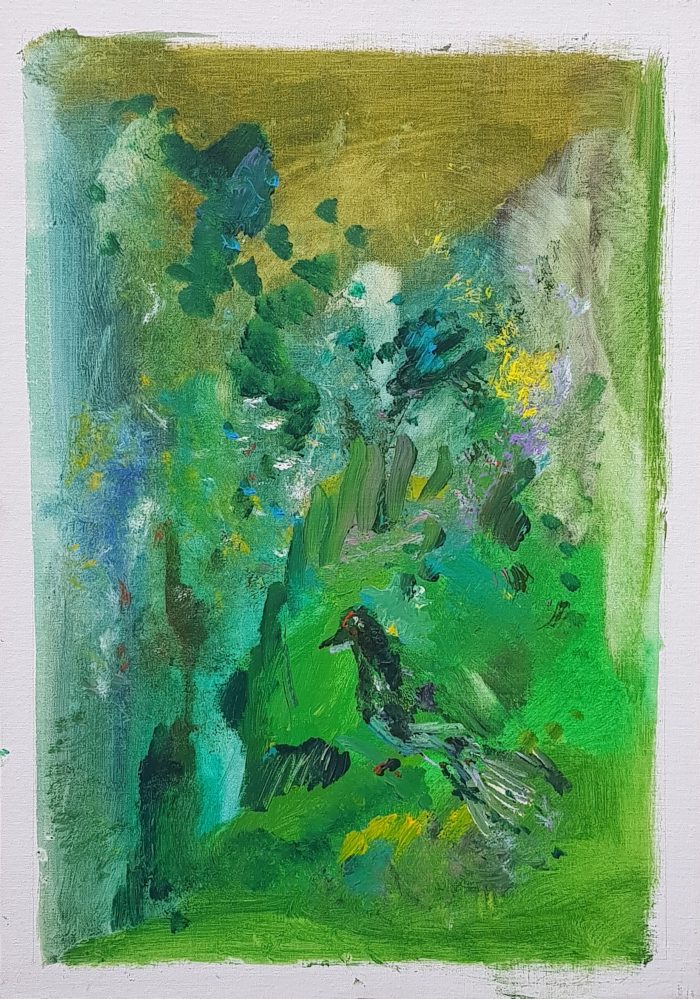
” every war is a civil war: every fallen man is similar to the one who remains, and he asks them the reason why.”
| Tu non sai le colline Cesare Pavese Tu non sai le colline dove si è sparso il sangue. Tutti quanti fuggimmo tutti quanti gettammo l’arma e il nome. Una donna ci guardava fuggire. Uno solo di noi si fermò a pugno chiuso, vide il cielo vuoto, chinò il capo e morí sotto il muro, tacendo. Ora è un cencio di sangue e il suo nome. Una donna ci aspetta alle colline. 9 novembre 1945 | You don’t know the hills Cesare Pavese You don’t know the hills where blood was spilled. We all ran away we all threw away our weapon and our name. One woman watched us flee. Only one of us stopped with fist closed, saw the empty sky, bowed his head and died under the wall, in silence. Now he is a bloody rag and his name. One woman is waiting for us at the hills. November 9, 1945 Translation ©Matilda Colarossi 2025 |
The poem “Tu non sai le colline” by Cesare Pavese is from the collection La terra e la morte (1947). He wrote the nine poems in this collection for Bianca Garufi.
In 1949, this poem, together with Terra rossa e terra nera were chosen to be included in the catalogue of paintings by Ernesto Treccani (cover image).
I wanted something special for today―April 25, Liberation Day, which commemorates the victory of the Italian resistance movement against Nazi Germany and the Italian Social Republic―because the world around us is changing rapidly―regressing, I should say―and this worries me; it scares me.
So I wanted to translate something that could maybe help understand what our comfortable lives, our freedom and, sometimes, our indifference have made us forget: for the freedom we have today, we must thank the numerous men and women of the Resistance, those who by sacrificing their lives gave us the chance to live ours freely.
The poem in its simplicity paints an indelible image: bloody hills, a woman watching, a fallen partisan (fist raised), a woman waiting.
We don’t know the hills, says the poet, we have not lived their war, but through his words we see how the endless civilian conflicts have drenched them in blood.
We don’t know anything about the men who threw down their weapons and ran away, but we perceive their spinelessness (“fuggimmo”, “gettammo”).
And we surely know that on those hills one man always remained, and his death has made his name forever known to us today[1].
All of the elements of Pavese’s art lie in these fourteen lines: the hills, nature ever present to witness the destruction caused by man; women―mothers, sisters, lovers―always watching (even when they would rather avert their eyes from the disgrace, or lack of morality, or cowardice), always waiting for the return of a loved one, of peace; overwhelming sadness.
Two different women at Pavese’s hills, and they change our perspective of the scene.
The first “woman who watched us flee” will be forever present in the conscience of those who threw down their weapons and threw away their “names” (Their true identities? After April 25, many men changed sides to save themselves from reprisal).
The second woman (be it mother, wife, sister or lover) stands waiting for the return of a loved one, of a future, of peace. She stands at the hills and we don’t know if she is waiting for the dead partisan, the “bloody rag” who although forever lost has maintained his name and his pride, or those who fought, those on both sides, those who ran.
Both women, like nature, witness the evil, the bloodshed, and, perhaps, are able to forgive.
Happy Liberation Day, lest we forget just how we got here. – M.C.
More about Liberation Day: https://www.wantedinrome.com/news/why-does-italy-celebrate-liberation-day-on-25-april.html
[1] Numerous poems and letters and accounts can be found here: https://paralleltexts.blog/category/25-aprile/
This work is licensed under CC BY-NC-ND 4.0
Painting: Ernesto Treccani
Tip jar
Choose an amount
Help keep paralleltexts publicity free…or, if you like, buy me a cappuccino!
Tip parallel texts: words reflected
Wonderful ♥️
LikeLike