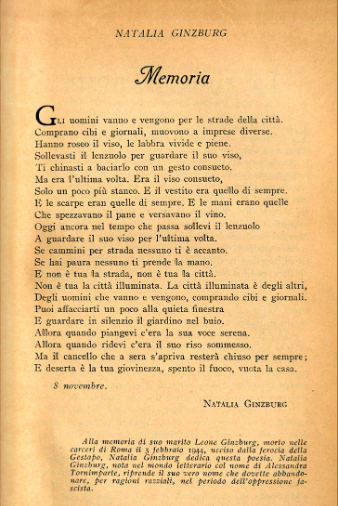
| Memoria Natalia Ginzburg Gli uomini vanno e vengono per le strade della città. Comprano cibo e giornali, muovono a imprese diverse. Hanno roseo il viso, le labbra vivide e piene. Sollevasti il lenzuolo per guardare il suo viso, ti chinasti a baciarlo con un gesto consueto. Ma era l’ultima volta. Era il viso consueto, solo un poco più stanco. E il vestito era quello di sempre. E le scarpe eran quelle di sempre. E le mani erano quelle che spezzavano il pane e versavano il vino. Oggi ancora nel tempo che passa sollevi il lenzuolo a guardare il suo viso per l’ultima volta. Se cammini per strada, nessuno ti è accanto, se hai paura, nessuno ti prende la mano. E non è tua la strada, non è tua la città. Non è tua la città illuminata: la città illuminata è degli altri, degli uomini che vanno e vengono comprando cibi e giornali. Puoi affacciarti un poco alla quieta finestra, e guardare in silenzio il giardino nel buio. Allora quando piangevi c’era la sua voce serena; e allora quando ridevi c’era il suo riso sommesso. Ma il cancello che a sera s’apriva resterà chiuso per sempre; e deserta è la tua giovinezza, spento il fuoco, vuota la casa. | Memory Natalia Ginzburg Men come and go along the roads of the city. They buy food and news-papers, they go to different jobs. They have rosy faces, full and vivid lips. You raised the sheet to look at his face, you bent over to kiss him the way you always did. But it was the last time. His face was as it always was just a little more tired. And his suit the same as always. And his shoes the same as always. And his hands were those that broke the bread and poured the wine. Today still in the time that passes, you raise the sheet to look at his face for one last time. If you walk along the road, no one is beside you, if you are afraid, no one takes your hand. And the road is not yours, the city is not yours. It is not your well-lit city: it is the well-lit city of others, of men who come and go, buying food and newspapers. You can lean out a bit of the quiet window, and look in silence at the dark garden. Once, when you cried, his calm voice was there; and once, when you laughed, his soft laugh was there. But the gate that once opened at night will remain closed forever; and deserted is your youth, gone the fire, empty the house. Translation ©Matilda Colarossi 2024 |
Natalia Ginzburg, whose maiden name was Natalia Levi, was born in Palermo in 1916. Her father Giuseppe Levi was a famous Jewish scientist from Trieste, while her mother was a Catholic from Milan. The name Ginzburg, which she chose to be identified with as a writer, was the name of her late husband Leone Ginzburg, whom she had married in 1938.
Natalia Ginzburg wrote this poem in memory of Leone who died in prison in Rome on 5 February 1944, after being beaten and tortured by fascists simply for being a Jewish intellectual and active antifascist. The poem was published in December 1944 in the literary journal “Mercurio”, here: https://www.bibliotecaginobianco.it/flip/MER/MER01-0400/.
The poem, which needs little explanation, captures the infinite pain caused by her husband’s death, her solitude and her suffering, in a poem where presence and absence seem to overlap, blurring the lines of what was and what is.
This work is licensed under CC BY-NC-ND 4.0 


 parallel texts: words reflected