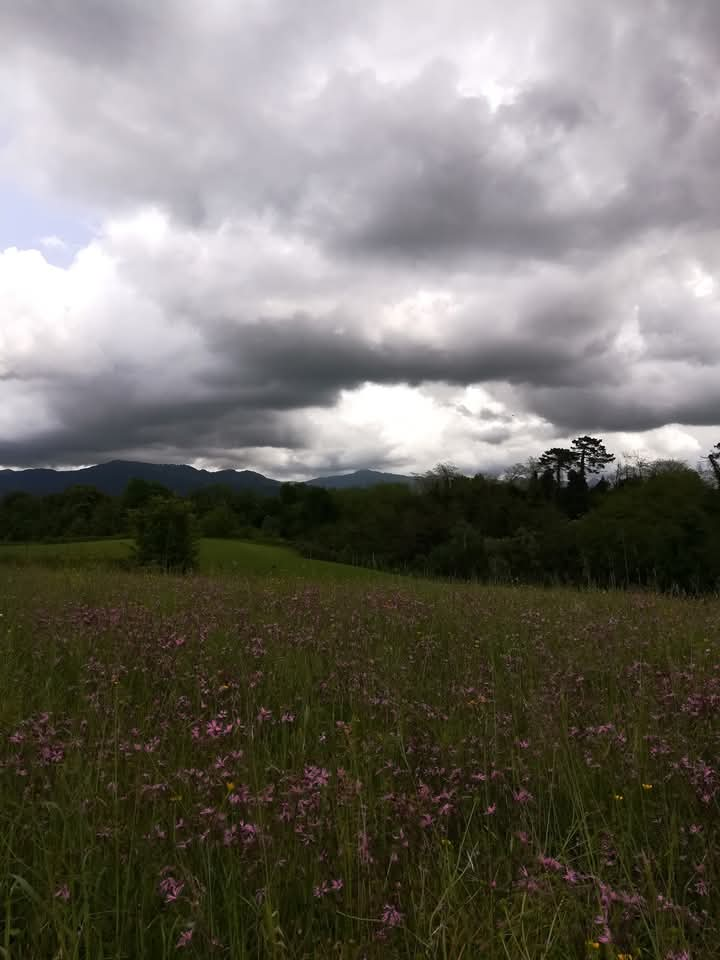
“These cantos, they linger, they linger on my father’s tomb!…They are the fluttering of birds, the rustling of cypress trees, the distant singing of bells: they are not exclusive to a cemetery. For some of my laments, I hope to be forgiven, so that less here than in any other place the reader might wish to say: What do I care about your pain?” – Giovanni Pascoli in the preface to Myricae. Livorno, March of 1894.
| SOLITUDINE Giovanni Pascoli I Da questo greppo solitario io miro passare un nero stormo, un aureo sciame; mentre sul capo al soffio d’un sospiro ronzano i fili tremuli di rame. È sul mio capo un’eco di pensiero lunga, nè so se gioia o se martoro; e passa l’ombra dello stormo nero, e passa l’ombra dello sciame d’oro. II Sono città che parlano tra loro, città nell’aria cerula lontane; tumultuanti d’un vocìo sonoro, di rote ferree e querule campane. Là genti vanno irrequïete e stanche, cui falla il tempo, cui l’amore avanza per lungi, e l’odio. Qui, quell’eco, ed anche quel polverìo di ditteri, che danza. III Parlano dall’azzurra lontananza nei giorni afosi, nelle vitree sere; e sono mute grida di speranza e di dolore, e gemiti e preghiere… Qui quel ronzìo. Le cavallette sole stridono in mezzo alla gramigna gialla; i moscerini danzano nel sole; trema uno stelo sotto una farfalla. | SOLITUDE Giovanni Pascoli I From this solitary ledge I spy the passing of a black flock, a gold cluster; while on my head at the whisper of a sigh buzz tremulous threads of copper. On my head is the echo of a thought prolonged, and I know not if of joy or torture; and passing is the shadow of the black flock and passing is the shadow of the gold cluster. II They are cities talking among themselves, cities in the distant cerulean skies; a thunder of sonorous voices, of iron wheels and querulous chimes. People move about, tired and restless, they want for time, their love advances swiftly, and hate. Here, that echo, and also that dusting of insects, which dances. III They speak from the distant blue on humid days, on vitreous evenings; and mute are their cries of hope and of pain, and sobs and praying… Here that buzz. The grasshoppers alone are chirping among the yellow wheatgrass; the fruit-flies are dancing in the sun; a stem is quivering under a butterfly’s mass. Translation ©Matilda Colarossi 2025 |
The city or the countryside? Bustling streets or quiet fields? The weight of love and hate unpronounced for lack of time or the easy contemplation of the countryside. The buzz of distant conversations along telegraph lines or that of the grasshoppers in the wheatgrass?
I know which I prefer. – M.C.
More about Giovanni Pascoli: https://paralleltexts.blog/tag/giovanni-pascoli/
https://creativecommons.org/licenses/by-nc-nd/4.0/
Tip jar
Choose an amount
Thank you for helping to keep paralleltexts.blog publicity free. Your contribution is appreciated.
Tip parallel texts: words reflected
Thank you Matilda!
Looking forward ro read your translation of this one one day: Giovanni Pascoli – Il gelsomino notturno
Thank you
Alessandro
LikeLike
Thank you for reading, Alessandro. I truly appreciate it!
Here is your wish ⬇️ (from 6 years ago! I have translated quite a bit by Pascoli. One day I hope to translate it all. I feel he is a kindred spirit.):
https://paralleltexts.blog/2019/01/15/il-gelsomino-notturno-the-night-blooming-jasmine-by-giavanni-pascoli/
Thank you again,
matí
LikeLike