| Dolore di cose che ignoro Salvatore Quasimodo Fitta di bianche e di nere radici di lievito odora e lombrichi, tagliata dall’acque la terra. Dolore di cose che ignoro mi nasce: non basta una morte se ecco più volte mi pesa con l’erba, sul cuore, una zolla. | Pain of things I ignore Salvatore Quasimodo Thick with roots of white and black of yeast smell and earthworms, cut by waters the land. Pain of things I ignore rises in me: one death does not suffice if again and again on me weighs with its grass, on my heart, a mound. Translation ©Matilda Colarossi 2025 |
In the first stanza of the poem Dolore di cose che ignoro, the poet introduces the elements that we so readily identify with his poetry, and the landscape is dense with symbols: the earth opening up as if cut by the water frees what is usually hidden from view, (“roots of white and black”, which recall Pascoli’s Lavandare “On the land half black and half grey “), and the smell of “lievito”, yeast―rising, expanding―and earthworms―which make the soil fertile. It is life, birth.
The second stanza directs our attention from nature to the poet himself, and to his endless pain. His pain of living, in fact, does not end with death, for the weight on his soul remains as the soil, too, weighs on his heart. It is interesting to note the use of the words “più volte” (again and again), which seems to suggest the weight is not only for his own death but “Death” in general, the death of so many before and after him.
One of the words I found most difficult to translate was zolla.
Zolla means “clump” of dirt/soil and is often used in relation to the land when tilled for sowing; it is also used to indicate a green patch of land or even a grassy mound (over a grave, for example). This variation in the meaning can, in Italian, lead to more than one interpretation of the verse, while in English, unfortunately, one word alone cannot. It is, therefore, up to the translator to choose, to “interpret” the poem for the reader. So along with the choice of words based on sound (which is always present in translation), it also falls upon the translator to give a “meaning” to the poem, a meaning which may very well not be the poet’s.
I chose “mound”: I saw the word to be associated with death, for, along with pain, it dominates the second stanza. In so doing, stanza one and two are in stark contrast: one, as life rises to the surface, fills us with hope; the other, as it plunges downward, expresses the hopelessness of trying to escape the pain of living.
I have included some examples of zolla found in famous Italian poems:
“I was born on the twenty-first in spring/but I didn’t know that being born mad,/opening clods /could unleash a storm.” (from Sono nata il ventun a primavera, Alda Merini: “Sono nata il ventuno a primavera/ma non sapevo che nascere folle,/aprire le zolle/potesse scatenar tempesta.”)
“your smile and your step/like waters that quiver-/your supple body/a tussock in the sun“ (from Hai un sangue, un respiro, Cesare Pavese: “il tuo riso e il tuo passo/come acque che sussultano -/la tua ruga fra gli occhi/come nubi raccolte -/il tuo tenero corpo/una zolla nel sole.”)
“What imaginings once, and what fancies /Were created in me by your being/ And those stars, your companions! when /in silence I sat on the mound of green,”! (from Le ricordanze, Giacomo Leopardi: “Quante immagini un tempo, e quante fole/creommi nel pensier l’aspetto vostro/e delle luci a voi compagne! allora/che, tacito, seduto in verde zolla,);
“Clumps of soil on the damp black field/glitter in the sun like a mirror:/they fill the peasant’s thoughts with bands of wheat,/ and the cuckoos’ song his ears.” (from Di Lassù, Giovanni Pascoli: “Qualche zolla nel campo umido e nero/luccica al sole, netta come specchio:/fa il villano mannelle in suo pensiero,/e il canto del cuculo ha nell’orecchio. ).
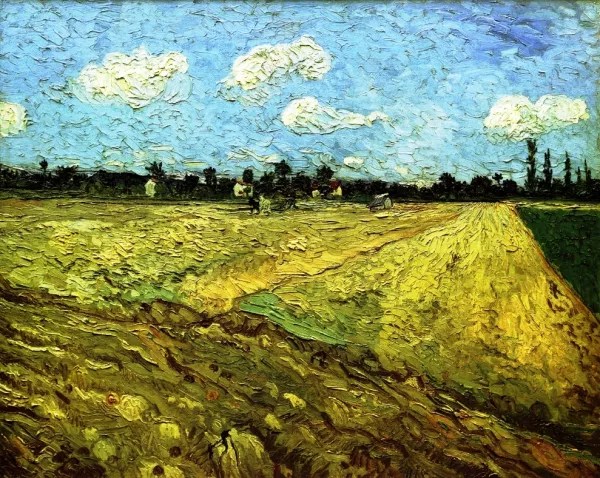
Painting: Ploughed field, Van Gogh, 1988
https://creativecommons.org/licenses/by-nc-nd/4.0/
Tip jar
Choose an amount
Thank you for helping to keep paralleltexts.blog publicity free. Your contribution is much appreciated.
Tip parallel texts: words reflected