“Exile is there, exile is plain/ everywhere…”

TRANSLATOR’S NOTE:
“I discovered Marie-Claire Bancquart in an anthology of 20th-century French poets during my first literary translation workshop in graduate school. I was immediately drawn to her language and her imagery—the way she brought ordinary things into her poems and elevated them to the same status as her references to Greek myths. “Earth!”, in particular, contains so many of the elements that appear again and again in her œuvre: an ambivalence about God (no doubt one reason why my translation of With Death, an Orange Segment Between Our Teeth was chosen for publication by Orison Books, a “non-profit literary press focused on the life of the spirit from a broad and inclusive range of perspectives”), a kinship with the natural world and its inextricable mixture of beauty and pain, and a delight in the taste of language and what it can do. The line that was the most difficult to translate in the whole poem was the one that reads simply “à corps gagné.” A literal translation would be something like “with body gained,” and a reader could be forgiven for taking it that way, as Bancquart loves to use language that is all the more mysterious for how simple it is. However, in French there is a set phrase, “à corps perdu,” which literally means “with body lost,” but translates to something more like “headlong” or “wholeheartedly.” I think Bancquart is clearly playing with that phrase here, turning the meaning on its head, not leaping or taking off by losing the body, but rather by gaining it. Thus, I took her invitation to play with language and invented a word of my own: “wholeheartlessly,” which takes one of the meanings of “à corps gagné” and turns it around. The precise meaning is not the same, but its playfulness and its role in the poem is preserved, and I hope readers who cannot otherwise appreciate the French will feel they are enjoying Bancquart’s work right along with me.” – ©Wendeline A. Hardenberg
ABOUT THE AUTHOR:
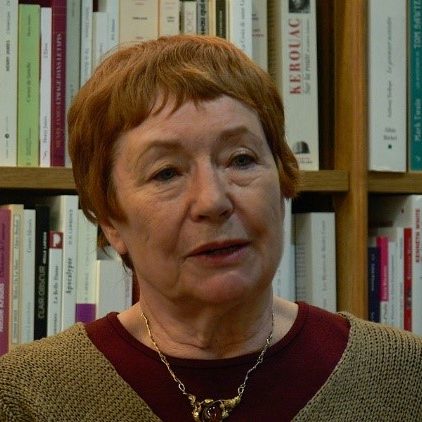
Marie-Claire Bancquart (1932–2019) was a prolific and prize-winning French poet, novelist, essayist, and critic, as well as a Professor Emerita of French literature at the Sorbonne. Her final book, De l’improbable, précédé de Mo(r)t, was published by Éditions Arfuyen in 2020.
Photograph: Mcbancquarttschann 20101019.JPG published under https://creativecommons.org/licenses/by-sa/3.0/ at https://en.wikipedia.org/wiki/Marie-Claire_Bancquart
ABOUT THE TRANSLATOR:

Wendeline A. Hardenberg studied at Smith College and Indiana University, where she earned a master’s degrees in Comparative Literature with a focus on translation and Library Science. She is the translator of numerous books, including The Bookshop of Forgotten Dreams by Emily Blaine, Will You Ever Change? by Aurélie Valognes, and Project Anastasis by Jacques Vandroux. Hardenberg’s translations have been published in Asymptote, Columbia Journal, Metamorphoses, Tupelo Quarterly, Two Lines, and other places. She lives in New Haven, Connecticut.
For more information about Wendeline A. Hardenberg’s work please visit: https://hardenbergtranslations.wordpress.com/
ABOUT THE PUBLISHER:
“Today, a significant gap exists between literary publishers and strictly religious publishers. Literary publishers occasionally publish books of spiritual depth, but few, if any, set out to do so as a mission and raison d’être. Religious publishers, on the other hand, tend to publish work that offers little appeal to readers outside a particular ideological group. Orison Books is a non-profit literary press that aims to address this gap through its focus on the life of the spirit from a non-ideological standpoint.
“Orison [“or-ĭ-sən”/“or-ĭ-zən”] is an archaic word that means ‘prayer.’ We at Orison Books believe that the best spiritual art and literature call us to meditate and contemplate, rather than asking us to adopt any ideology or set of propositions. This type of art evokes the human experience of transcendence and explores the mysteries of being, and in so doing opens our minds and hearts to the divine and the possibility of becoming the fullest humans we can be. In our view, spiritual writing has little to do with subject matter. Rather, the kind of work we seek to publish has a transcendent aesthetic effect on the reader, and reading it can itself be a spiritual experience.” – Orison Books
For more information about Orison Books, their publications and their mission, please visit: https://www.orisonbooks.com
I would like to thank Wendeline Hardenberg and Orison Books for permission to publish this wonderful poem on my blog.
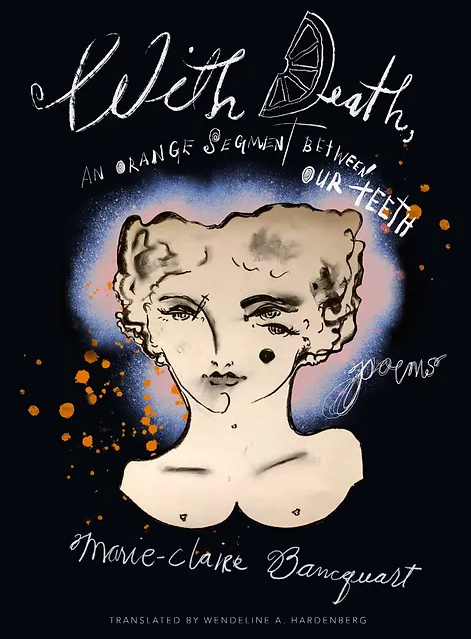
You can order your copy of the book “With Death, an Orange Segment Between Our Teeth, poems” by Marie Claire Bancquart here: https://www.orisonbooks.com/product-page/with-death-an-orange-segment-between-our-teeth-poems-by-marie-claire-bancquart
© All rights reserved
 parallel texts: words reflected