
|
Soldati Giuseppe Ungaretti Si sta come d’autunno sugli alberi le foglie Bosco di Courton luglio 1918
|
Soldiers Giuseppe Ungaretti We are as in autumn on branches the leaves Courton Forest, July 1918 Translation ©Matilda Colarossi |
The poem was originally written in July 1918, in the trenches near a forest in Courton, Reims, and was published in the magazine «La Raccolta». Here we find the essence of Ungaretti’s poetry: the tragedy of existence but especially that of war. Soldati (Soldiers), in its brevity, reflects the author’s sudden understanding of the absurd condition of his fellow soldiers but also of his fellow men. It underlines the irrationality of the human condition and the inevitable end we must all face. It renders all men no different than leaves that in autumn fall from the branches, following the natural course of nature.
It is, here, interesting to note that the comparison between the death of man and the falling of leaves is not uncommon to classical literature. In the Aeneid, Books I-VII, for example, we find “And youths, entombed before their father’s eyes/With hollow groans, and shrieks, and feeble cries./Thick as the leaves in autumn strow the woods…”; while in The Divine Comedy: Volume 1: Inferno, we can read “As in autumn the leaves drop off one after the other till the branch sees all its spoils on the ground, so the wicked seed of Adam fling themselves from that shore one by one …”.
There are so many different translations of this brief poem, all of them beautiful. I, however, tried to move away from their more straightforward, self-explanatory, solutions, imitating, as best I could, what the author chose to do. In this poem, in fact, we find two heptasyllables (si sta come le foglie [we are like leaves]; and d’autunno sugli alberi [in autumn on branches*], which the author divided into four verses. He introduces the simile in the first line but only sets the comparison in the last one, while isolating the essential spatial-temporal elements (in autumn/ on branches*) in the second and third verse. I found it impossible to reproduce two heptasyllables (divided into tetrasyllable/trisyllable; trisyllable/tetrasyllable) without adding unnecessary words, and propose one pentasyllable (trisyllable/disyllable) and one hexasyllable (trisyllable/trisyllable).
*I opted for the word ‘branches’ instead of the literal ‘trees’ for the musicality: there is no end rhyme in the poem in Italian.
As always, so much is lost in translation.
To enjoy Ungaretti’s complete works:
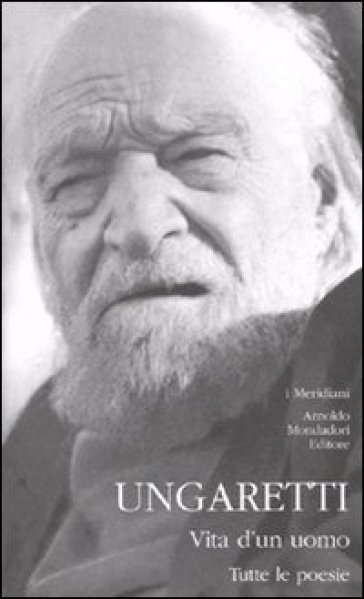
https://www.mondadoristore.it/Vita-d-un-uomo-Tutte-poesie-Giuseppe-Ungaretti/eai978880458349/

This work is licensed under a Creative Commons Attribution-NonCommercial-NoDerivatives 4.0 International License.
 parallel texts: words reflected
Reblogged this on Paolo Ottaviani's Weblog.
LikeLike
This was one of the poems my Italian tutor showed me while I was still learning! Thank you for the analysis; certainly a lot more going on than I expected.
LikeLike
I hope it was of some help. Thank you for reading my blog. M.
LikeLike
FABULOUS! In four verses, a great tragedy of humanity
LikeLiked by 1 person
Have you translated Fratelli?
LikeLike
No, I haven’t!
LikeLike
Nicest translation I’ve seen. Branches for trees makes it work; the sound and the particularity.
LikeLike
Thanks again for the answer to my modest comment. Yes, you guessed right: I’m not a native speaker, I’m Italian, just studying English, and loving learning English’ authors, the most important being Seamus Heaney, Sharon Old, Louise Gluck, and Robert Frost. I make mistakes, as you saw, despite of my English teacher who is trying to correct my fossilized errors. Thank you for your suggestion. I just know Solitudini, and certainly the poet is referring also to himself. A poet (that I am) can’t write about feelings if they don’t know the emotions which they want to write about. But he doesn’t write explicitly using his pronoun. Obviously, I don’t want to say that your translation is wrong, only I disagree, and I said this just to have a discussion. Your replay was perfect, telling me about metre and your personal sensations.
Mine are different.
I very appreciate your replay.
LikeLike
Please don’t worry about mistakes, or rather, slips in English. After numerous years in Italy and a degree in Italian, if I were to write to you in Italian, you’d immediately know I wasn’t a native speaker (whatever that truly means given my origins)!
I liked the exchange too.
I have a whole long process in my head when I translate, but I rarely give the details…sometimes I actually forget why I did what. And sometimes, years later, I would translate something totally different, which is why I said “what I hear”. It’s what I heard then, with the knowledge I had then, the feelings I had then (of loneliness or other things)!
Thank you again for writing. I do appreciate it and love the exchange.
M.
LikeLiked by 1 person