In this poem, Gabriele D’Annunzio recalls the Christmas Eves of his childhood in Ceppo, the simpler, more carefree times, and two of the people he loved most: his mother and his paternal grandmother…
Audio: 1-Italian
Audio: 2-English
| Il Presepio Gabriele D’Annunzio A Ceppo si faceva un presepino con la sua brava stella inargentata, coi Magi, coi pastori, per benino e la campagna tutta infarinata. La sera io recitavo un sermoncino con una voce da messa cantata, e per quel mio garbetto birichino buscavo baci e pezzi di schiacciata. Poi verso tardi tu m’accompagnavi alla nonna con dir: “Stanotte L’Angelo ti porterà chi sa che bei regali!”. E mentre i sogni m’arridean soavi, tu piano, piano mi venivi a mettere confetti e soldarelli fra’ i guanciali. | The Manger Scene Gabriele D’Annunzio In Ceppo they made a little manger scene with its pleasant silvery star, with Wise Men, with shepherds, ably, and the countryside sprinkled in flour. At night I would recite a little homily as the missa cantata is sung, and for my mischievous affability I got kisses and bits of crunchy almond. When it was late, you’d accompany me to nonna and you’d hint: “Who knows what fine gifts the Angel will bring to you this night!” And while dreams smiled upon me gently, you came ever so quietly to set neath my pillow small coins and candy. Translation ©Matilda Colarossi 2023 |
In this poem, the poet, Gabriele D’Annunzio, recalls the Christmas Eves of his childhood. His memory takes him back to simpler, more carefree times and two of the people he loved most: his mother Luisetta De Benedictis, with whom he had an extremely close relationship, and his paternal grandmother Anna Lolli.
“In Ceppo” begins the poet, referring to the mountain location in Abruzzo at the foot of the Monti della Laga―the place where D’Annunzio spent his Christmas holidays as a child with his family and his paternal grandmother Anna Lolli―“they made a little manger scene…”
Thus the poet sets the tone for this lovely poem in rhyme: he describes a time and place from which the warmest, most loving memories stem. That presepino, like everything else he describes, is unpretentious: the star is “brava” (pleasant); the display is “per benino” (ably presented); the countryside is “infarinata” (sprinkled in flour). Yet the feeling we get is of something superlative, unreachable almost, of extreme happiness and love.
The poet continues by introducing his younger self, the much-loved child who on Christmas Eve recites his “homily”, “as the missa cantata is sung” (alluding to his future as not just any poet but the poet, il vate), with “garbetto birichino”, mischievous affability. I found this part especially insightful because it gives me an understanding of the man he would become and why: his little speech, sung as one would in high mass, was greatly rewarded “with kisses and bits of crunchy almond”, just as his poems and wild adventures would be later on in life. The tone of the poem remains intimate, familiar, and we come to meet the poet’s mother and her words to him, the only dialogue present in the poem, “Stanotte L’Angelo / ti porterà chi sa che bei regali!” It is a promise, it is comfort afforded to the child by those who adore him. And sure of this love and protection, the child sleeps enveloped in happy dreams.
The poem is written in rhyme, and this greatly conditioned my translation. In order to maintain the musicality and the poetic devices, I was forced to take certain liberties: the syntax is sometimes different, the translation of the words is hardly ever literal. I tried to keep the tone simple and was sometimes incapable of doing even this, for example in my choice of the words “homily” and “neath”, which was necessary for the rhyme, in the first case, and the rhythm, in the second. I tried to reproduce the poet’s choice of words, but in English some forms were impossible for me to reproduce while trying to recreate the music of the original: “brava stella” (cute little star), “per benino” (well, fairly well), “birichino” (little rascal), “buscavo”(earning, receiving, but very informal), “soldarelli” (pennies, also informal and a term used mostly for children), and, of course, “schiacciata” (a sort of almond brittle) and “confetti” (sugar coated almonds). As always, I did my best, which is never enough when translating poetry, especially poetry in rhyme. – M.C.
This translation is accompanied by my recordings of the two poems (because, in the end, they are, in fact, two slightly different poems).
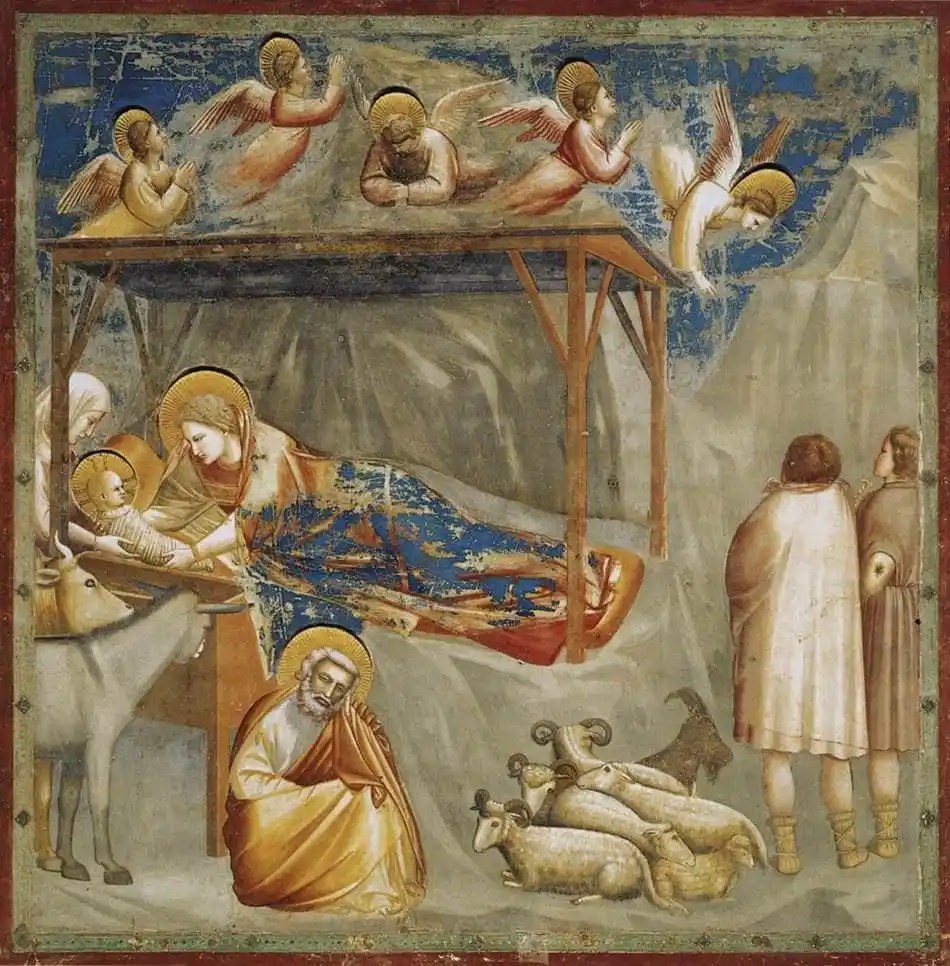
Painting: Giotto di Bondone, Natività di Gesù (1303-1304)
This work is licensed under CC BY-NC-ND 4.0
 parallel texts: words reflected